
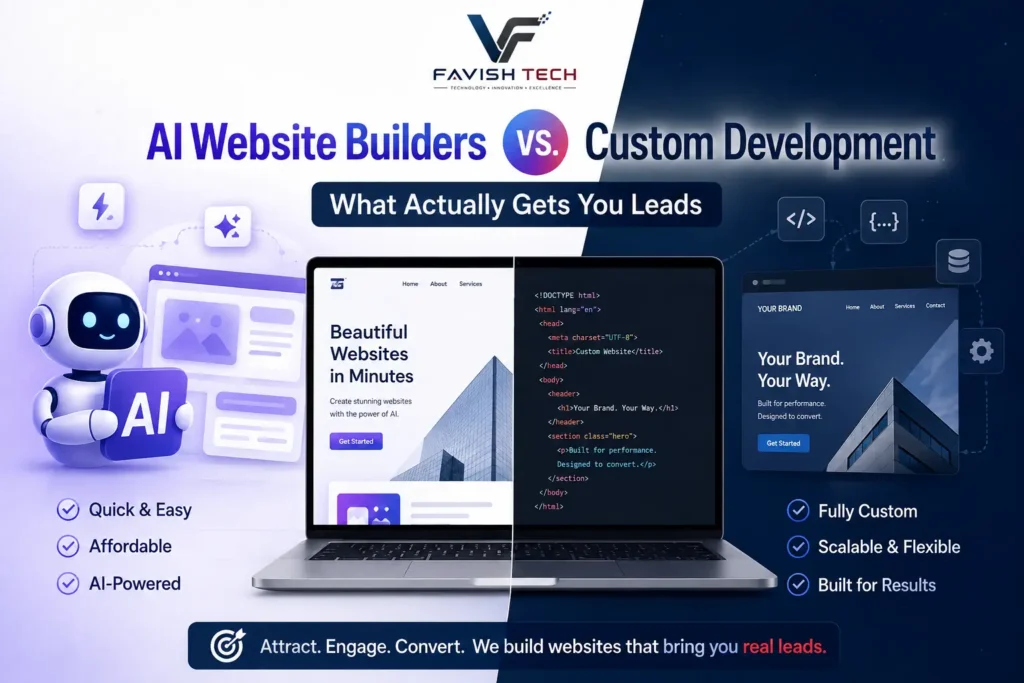
If you’ve typed “build a website with AI” into Google lately, you’ve seen the promise: a professional-looking site in minutes, no coding required. For a lot of small business owners, that sounds like the answer. But there’s a difference between a website that looks finished and one that actually works, and that difference shows up the moment you try to rank on Google, connect a custom domain, or add anything beyond the template.
Here’s what AI builders are genuinely good for, where they fall short, and how to think about the decision.
Where AI website builders actually help
To be fair to the tools, platforms like Wix’s AI builder aren’t useless. They’re a good fit when:
- You need a placeholder site live today, before funding or before the “real” site is ready
- You’re testing a business idea and don’t want to invest in development yet
- You need a short-lived landing page for a single campaign or event
- Budget is genuinely zero, and some site is better than none
If that’s you, use the AI builder. The problem is when a “temporary” site quietly becomes the permanent one.
Where they fall short and why it matters for lead generation
1. Ranking on Google takes ongoing work, not a one-time setup.
An AI builder can generate a site with reasonable on-page SEO defaults. What it can’t do is the continuous work: content strategy, backlinks, technical SEO, structured data, and monitoring what’s actually moving your rankings. SEO is a process, not a feature you switch on and most builders give you basic settings while limiting control over structured data, page hierarchy, internal linking, and Core Web Vitals, which are exactly the things that move competitive keywords.
2. Custom domains and business email aren’t as automatic as they look.
Connecting your own domain and setting up professional email (yourname@yourbusiness.com) is possible on most builders, but it usually means an extra paid plan, manual DNS configuration, and a real risk of breaking email deliverability if it’s set up wrong. This is a one-time task that’s easy to get wrong without technical help and gets expensive to fix later if search engines or email providers flag your domain.
3. Speed and structure affect conversions more than people expect.
A 0.1 second improvement in page speed has been shown to lift conversions by measurable amounts in retail and travel, and slow pages lose a majority of mobile visitors before they even load. AI builders run on shared, platform-level infrastructure, so you have limited ability to optimize this you’re working within their system, not your own.
4. Customization hits a wall.
The first few changes are easy. Then you want a specific booking flow, a membership area, an integration with your CRM, or a page layout the template doesn’t support — and you’re stuck, because AI-generated code isn’t built to be hand-edited by a developer later. At that point, businesses often end up migrating to a custom build anyway, just later and more expensively.
The real question isn’t “can I build a website” it’s “what’s the return on it”
A nice-looking site isn’t the goal. Leads, bookings, and sales are the goal. That reframes the comparison:
| AI Website Builder | Custom Development | |
|---|---|---|
| Speed to launch | Hours | Weeks |
| Upfront cost | Lower | Higher |
| SEO ceiling | Limited by platform | Full control |
| Custom domain/email setup | Manual, error-prone | Set up correctly once |
| Long-term scalability | Limited | Built for growth |
| Best for | MVPs, placeholders, campaigns | Businesses relying on organic traffic and lead gen |
Custom development typically costs more upfront, but it pays back through better conversion, reliable integrations, and full control over your data and SEO strategy — the exact things that generate leads over the long run, not just a good first impression.
Bottom line
If you’re validating an idea or need something live by tomorrow, an AI builder is a reasonable stopgap. But if your website is meant to be a growth engine bringing in leads consistently, ranking for the keywords your customers actually search it needs the strategy, technical setup, and ongoing optimization that only comes from working with someone who understands both the code and the business goal behind it.
That’s the gap we help close at Favish Tech. Contact Us
FAQ
Can AI-generated websites rank on Google?
Yes, but ranking well — especially for competitive keywords — is difficult. AI builders offer basic SEO settings, but limit control over technical elements like structured data, internal linking, and page speed, which matter most for ranking.
Is it more expensive to hire a developer instead of using an AI builder?
Upfront, yes. AI builders are cheaper to start. But when you factor in add-ons, premium templates, third-party integrations, and eventual migration costs, the total cost of ownership often evens out — while a custom site typically delivers a stronger return through better conversion and control.
Can I connect a custom domain and business email to an AI website builder?
Usually, yes — but it often requires a paid plan and manual DNS setup, and mistakes here can break email deliverability. It’s a small technical task that’s worth getting right the first time.
When should I upgrade from an AI builder to a custom website?
When you need advanced SEO, custom functionality (booking systems, membership areas, integrations), better site speed, or when lead generation — not just having a website — becomes the priority.
Do I need to know how to code to maintain a custom website?
No. A good developer sets it up so you can update content easily, while still handling the technical/backend work (hosting, security, SEO, integrations) that keeps the site performing.