
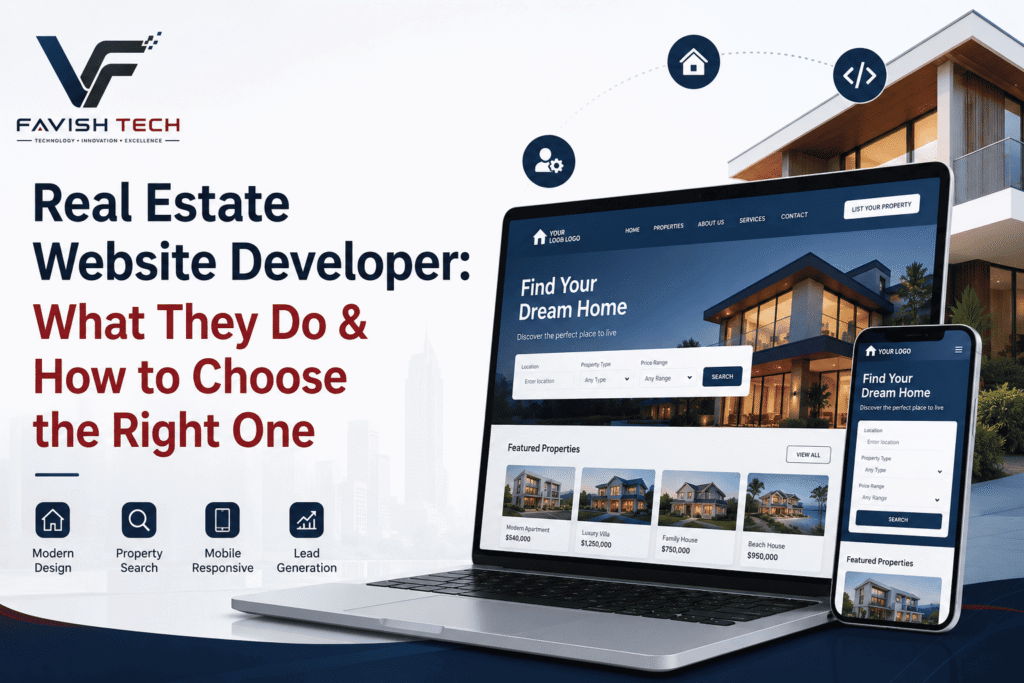
If you’re in real estate, whether you’re an individual agent, a brokerage, or a property developer, your website is often the first impression a potential client gets of your business. A generic template site won’t cut it anymore. That’s where a dedicated real estate website developer comes in.
In this guide, we’ll break down exactly what a real estate website developer does, the features your site actually needs, and how to choose the right one for your business.
What Does a Real Estate Website Developer Do?
A real estate website developer builds websites specifically designed for the real estate industry — not just a generic business site, but one built to handle property listings, buyer inquiries, and lead generation at scale. Their work typically includes:
- Property listing systems — searchable, filterable databases of available properties
- IDX/MLS integration — pulling live listing data from real estate databases so your site stays updated automatically
- Lead capture tools — contact forms, scheduling tools, and CRM integrations that turn visitors into leads
- Mobile-responsive design — since most property searches now start on a phone
- SEO-friendly structure — so your listings and pages actually show up in search results
Why a Generic Web Developer Isn’t Always Enough
Real estate websites have specific technical needs that a general-purpose developer may not be familiar with — things like IDX feed integration, map-based property search, and handling large volumes of listing data without slowing the site down. A developer with real estate experience already knows these pitfalls and builds around them from day one, saving you time and rework later.
Must-Have Features on a Real Estate Website
If you’re evaluating a website (yours or a developer’s past work), here’s what to look for:
- Advanced property search — filters for price, location, property type, bedrooms, etc.
- High-quality image and video support — including virtual tours for higher-end listings
- Lead capture at every stage — not just a “contact us” page, but forms tied to specific listings
- Fast load times — real estate sites are image-heavy, so performance optimization matters
- Local SEO setup — so you show up when people search for real estate in your city or region
How to Choose the Right Real Estate Website Developer
When comparing developers, ask about:
- Experience with real estate-specific tools (IDX, MLS, CRM integrations)
- Portfolio of past real estate projects — ask to see live examples, not just mockups
- Ongoing support — real estate sites need updates, security patches, and listing management support after launch
- SEO knowledge — a developer who understands real estate SEO will set your site up to actually rank, not just look good
Final Thoughts
Whether you’re a solo agent, a growing brokerage, or a commercial/luxury property developer, your website needs to do more than look professional — it needs to generate leads and convert visitors into clients. Working with a developer who understands the real estate space from the ground up makes that possible.
Looking for a real estate website developer who gets it right the first time? Get in touch with Favish Tech to discuss your project.