
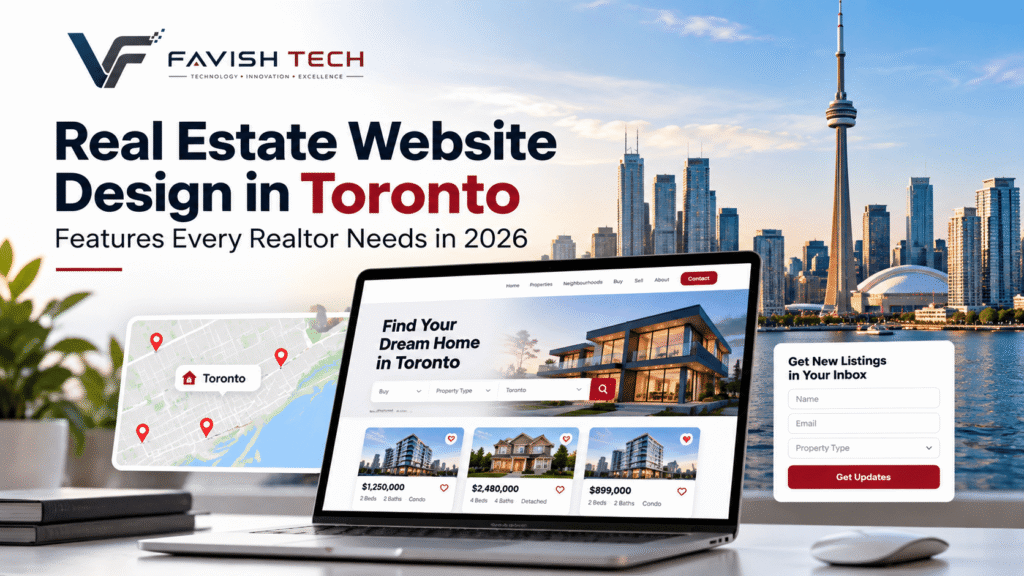
Toronto’s real estate market is highly competitive. Buyers and sellers often research properties, agents, reviews, and local neighborhoods online before deciding who to contact.
That makes a professional real estate website design in Toronto an important part of a realtor’s digital presence. Your website can showcase properties, build your personal brand, generate enquiries, and provide useful information to potential clients.
But what should a modern Toronto realtor website include?
Why Toronto Realtors Need a Professional Website
Social media and property platforms can help realtors reach potential clients, but they don’t provide the same level of control as your own website.
A professional Toronto realtor website gives you a central place to:
- Showcase your properties
- Explain your services
- Build your personal brand
- Generate buyer and seller leads
- Publish Toronto real estate content
- Display testimonials
- Provide contact options
- Support local SEO
Your website can work alongside property portals and social media rather than depending entirely on them. Contact Us
1. Professional Realtor Website Design
First impressions matter. Your website should immediately communicate who you are, what you specialize in, and which areas you serve.
A modern realtor website design in Toronto should include:
- Clean navigation
- Professional branding
- High-quality property images
- Clear calls-to-action
- Mobile-friendly design
- Easy contact options
- Fast-loading pages
Your website should also reflect your individual brand instead of looking like a generic template.
2. Property Search and Listings
Property search is one of the most important features for a real estate website.
Visitors should be able to search and filter properties based on relevant criteria such as:
- Location
- Price
- Property type
- Bedrooms
- Bathrooms
- Listing status
- Other applicable property characteristics
Individual listing pages can include property photographs, descriptions, features, maps, videos, floor plans, and contact options.
A well-designed property listing website in Toronto makes it easier for visitors to explore properties and contact the realtor.
3. IDX and MLS Integration
Many realtors want their website to provide an integrated property-search experience.
Depending on the applicable MLS or real estate board, data provider, permissions, and technology solution, an IDX real estate website may allow property information to be searched directly through the realtor’s website.
Before implementing any MLS or IDX solution, realtors should confirm the current rules, licensing requirements, and data permissions applicable to their setup.
4. Mobile-Friendly Design
Real estate websites need to work well on smartphones.
Potential buyers may discover a property while using their phone and immediately want to view photographs, check details, or contact an agent.
A professional real estate web design in Toronto should work smoothly across:
- Smartphones
- Tablets
- Laptops
- Desktop computers
Visitors should be able to search listings and submit enquiries without struggling with the layout.
5. Local SEO for Toronto Realtors
A website needs to be discoverable as well as attractive.
Real estate SEO in Toronto can help your website target relevant searches related to your services and locations.
Potential topics and keywords include:
- Toronto real estate
- Toronto realtor
- Toronto real estate agent
- Toronto homes for sale
- Toronto condos
- Downtown Toronto real estate
- North York real estate
- Scarborough real estate
- Etobicoke real estate
Your website should also have strong technical SEO, including optimized titles, meta descriptions, headings, internal links, image optimization, mobile performance, clean URLs, and an XML sitemap.
The goal should be to create genuinely useful content rather than simply repeating keywords. Contact Us
6. Toronto Neighborhood Pages
Toronto has many neighborhoods, and buyers often search specifically for information about the areas they’re interested in.
Depending on the areas you serve, you could create useful pages covering communities such as:
- Downtown Toronto
- North York
- Scarborough
- Etobicoke
- York
- East York
- The Beaches
- Leslieville
- Yorkville
A neighborhood page could discuss local housing types, amenities, transportation, lifestyle, and real estate considerations.
Each page should offer unique value rather than simply replacing the city name in the same template.
7. Lead Generation
Your website should make it easy for visitors to become potential clients.
Useful calls-to-action include:
Book a Consultation
Request a Viewing
Ask About This Property
Get a Home Valuation
Contact a Realtor
You can also create separate forms for buyers and sellers.
For example, a buyer form could collect preferred location, budget, property type, and buying timeframe, while a seller form could collect property information and the expected selling timeframe.
Keep forms simple so visitors aren’t discouraged from submitting them.
8. Realtor Profile and Testimonials
Real estate is a relationship-driven business. Potential clients want to know who they will be working with.
Your website should include an informative About page covering your:
- Experience
- Professional background
- Service areas
- Specializations
- Credentials
- Client approach
You can also display genuine client testimonials throughout your website.
Reviews can be particularly useful on your homepage, buyer services page, seller services page, and contact page.
9. Useful Real Estate Content
A Toronto real estate website can become more valuable when it provides useful information.
Consider publishing:
- First-time buyer guides
- Toronto neighborhood guides
- Home-selling tips
- Market updates
- Condo buying guides
- Home preparation checklists
- Real estate FAQs
Useful content can help answer client questions while creating additional opportunities for organic search visibility.
10. Website Speed and Security
Real estate websites often contain large photographs, videos, maps, and third-party integrations. Without proper optimization, these elements can slow down the website.
Professional real estate website development in Toronto should consider:
- Image compression
- Caching
- Reliable hosting
- Mobile performance
- HTTPS security
- Regular backups
- Software updates
- Core Web Vitals
A fast and secure website creates a better experience for visitors.
11. Easy Contact and Booking
Don’t make potential clients search for your contact information.
Include clear options such as:
Call | Email | Contact Form | Book a Consultation
Appointment booking can also allow visitors to select an available time without going through multiple messages.
For mobile users, click-to-call functionality can make contacting you even easier. Contact Us
12. Analytics and Tracking
Website analytics can help realtors understand how visitors interact with their websites.
You can learn:
- Where visitors come from
- Which pages receive traffic
- Which listings attract attention
- Which content performs well
- Which pages generate enquiries
These insights can help you improve your website and digital marketing strategy. Contact Us
How to Choose a Real Estate Website Design Company
When selecting a real estate website design company, don’t focus only on visual design.
Ask about:
- Previous real estate projects
- Property search functionality
- MLS/IDX requirements
- Mobile responsiveness
- SEO
- Website speed
- Security
- Maintenance
- CRM integrations
- Lead-generation features
A good development partner should understand both the technical requirements and the business objectives behind your website. Contact Us
FAQ
Do Toronto realtors need their own website?
A website provides a dedicated platform for your brand, services, property information, lead generation, and SEO. It can complement social media and property portals.
What should a Toronto realtor website include?
Important features can include property search, listing pages, mobile-friendly design, lead forms, agent profiles, testimonials, local SEO, useful content, analytics, and appropriate MLS/IDX functionality.
Is IDX available for Toronto realtors?
IDX and MLS functionality depends on the applicable real estate board, data provider, permissions, licensing, and technology solution. Realtors should verify the current requirements before implementation.
How important is SEO for Toronto realtors?
SEO can help potential clients discover your website when searching for real estate services, properties, neighborhoods, and useful buying or selling information.
Should I create Toronto neighborhood pages?
Yes, when you genuinely serve those areas and can provide useful, original information. Avoid creating large numbers of duplicate pages simply for SEO.
Should a realtor website be mobile-friendly?
Absolutely. Your website should provide a smooth experience on smartphones, tablets, and computers.
Can a realtor website generate leads?
Yes. Contact forms, viewing requests, consultation bookings, home valuation forms, and clear calls-to-action can help turn website visitors into enquiries.
Final Thoughts
A successful real estate website design in Toronto should do more than look professional. It should help visitors discover your services, explore properties, understand your expertise, and contact you easily.
With the right combination of property search, appropriate MLS/IDX functionality, mobile design, local SEO, lead generation, useful content, security, and performance, your website can become an important part of your real estate marketing strategy in 2026.
If you’re planning a Toronto realtor website, focus on building a useful experience for your clients—not simply another online profile. Contact Us