
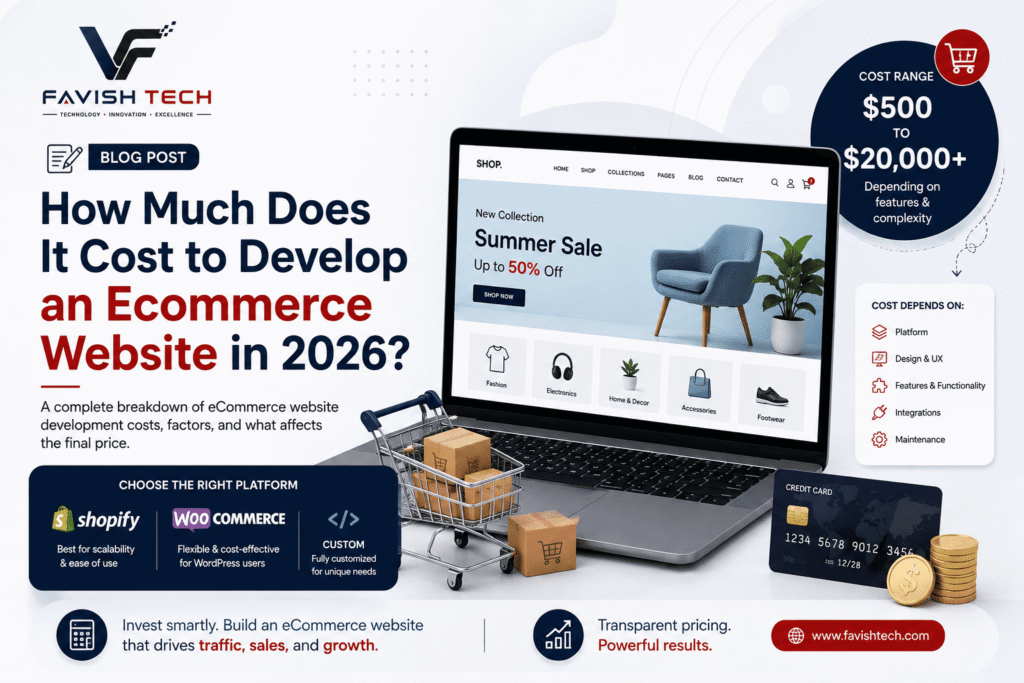
If you’ve been asking around about ecommerce website development cost, you’ve probably gotten five different answers from five different people — and none of them matched. That’s not because anyone’s lying to you. It’s because “how much does an ecommerce website cost” is a bit like asking “how much does a house cost.” It depends entirely on what you’re building.
So instead of throwing a random number at you, let’s actually walk through what drives the cost of an ecommerce website up or down, so you know what you’re paying for before you sign anything.
The “just getting started” store
If you’re a small business owner launching your first online store — a handful of products, a clean design, working cart and checkout — this is usually the cheapest tier. You’re not paying for custom functionality here, you’re paying for a solid, working foundation. WooCommerce and Shopify both handle this well, and honestly, for most first-time store owners, this is exactly where you should start. No point overbuilding before you know what your customers actually respond to.
The “we’re actually growing” store
This is where most of our clients land. You’ve got more products, you want the site to actually look like your brand instead of a template, and you need things like filtering, wishlists, multiple payment options, maybe a loyalty program. The price jumps here — not because developers are padding the bill, but because custom ecommerce design and extra functionality genuinely take more hours to build and test properly.
The “we need something built specifically for us” store
Multi-vendor marketplaces, subscription billing, custom integrations with your inventory or CRM system — this is a different category entirely. It’s not really “a website” at this point, it’s closer to custom software with a storefront attached. Naturally, this costs the most, and it should — you’re paying for engineering, not templates.
Here’s the thing nobody tells you upfront
The development cost is only half the story. What actually determines your long-term spend is stuff like: how many products you’re managing, whether you need custom design or a template works fine, which payment gateways and shipping tools you’re plugging in, and — this one gets skipped constantly — what happens after launch.
We’ve seen business owners save a couple thousand dollars on development by going cheap, then lose way more than that in downtime, security issues, or a checkout that quietly broke and nobody noticed for two weeks. A website isn’t a one-time purchase. It’s closer to a car — the sticker price isn’t the real cost, ecommerce website maintenance is.
So what should you actually do?
Don’t shop by price alone. Ask what’s included. Ask who handles it if something breaks in month three. Ask whether SEO setup is part of the build or a separate line item you’ll need later anyway. A cheaper quote that leaves out half of what you need isn’t actually cheaper.
If you want an honest read on what your specific business would actually need — not a generic package — happy to walk through it with you. No pressure, just a real conversation about what makes sense for where you’re at.
FAQs
Q1. How much does a basic ecommerce website cost?
A basic store with essential product pages, cart, and checkout is the most affordable option, best suited for small businesses launching their first online store.
Q2. Is Shopify or WooCommerce cheaper to build?
WooCommerce usually has lower long-term platform costs since there’s no mandatory subscription, but Shopify often has a faster, more predictable setup cost. The right choice depends on your business needs, not just price.
Q3. Does ecommerce website cost include maintenance?
Not usually. Development and maintenance are typically separate. Always ask upfront whether ongoing updates, security, and support are included or billed separately.
Q4. Why do custom ecommerce websites cost more?
Custom websites involve unique functionality — like multi-vendor systems, subscriptions, or CRM integrations — that require custom engineering rather than pre-built templates.
Q5. What affects ecommerce website pricing the most?
Number of products, design customization, third-party integrations, payment gateways, and whether SEO/content setup is included all impact the final cost.